Immerse yourself in the vibrant heritage of Wales, explore the meaning behind the golden dragon, and envision a future for Wales characterised by five kingdoms, fifteen castles, and a modern charter inspired by the Laws of Hywel Dda.
Embracing Unity: Five Kingdoms and the Golden Dragon of Wales
They call me Goldie The Grey.
The mention of gold deserves some explanation, while the grey is quite clear.
But what is the story behind the golden dragon?
There is a tale ready to unfold. So, grab your drink—whether it’s coffee, tea, or something stronger. Sit back and allow yourself to be drawn into the narrative I’m about to share.
Beginning the Adventure of Exploration
One might expect the adventure to kick off with a sword, an ancient prophecy, or a mysterious figure appearing on a stormy night.
My journey, however, begins with a commitment to digitise my mother’s documents for future generations.
That’s quite a weighty responsibility, wouldn’t you agree?
Family documents seldom remain just that. A name becomes a question. A lineage unfolds into an epic journey. Before long, you find yourself staring at a family tree, pondering how much of your identity you truly understood before setting out on this path.
At some juncture in this exploration, the narrative grew far beyond merely securing my mother’s paperwork.
Unearthing the Names that Bind Us Together
As I delve into my ancestry, I discover that I am thirty-five generations removed from Rhodri Mawr.
This connection carries weight. Tracing these generations is vital, as a family tree signifies more than a simple link between a monarch and a present-day descendant.
There are individuals who bridge the gap.
Individuals with families to nurture, children to guide, losses to endure, and choices to make.
Individuals whose lives deserve more than a fleeting mention en route to a notable name.
I yearn to uncover their stories, too.
I aspire to create space for familial narratives that don’t fit neatly into a chart.
For the House of Rhodri, as I’ve come to call it, is quite unconventional.
A House Filled with Diverse Histories
Witches. Mages. Shamans. Seers. Healers. Empaths. Mystics.
These labels capture the essence of the mystical experiences within my family.
Not everyone would use the same descriptors. Each generation may have interpreted these terms uniquely.
I don’t suggest that every ancestor documented their extraordinary abilities.
My mother had enough paperwork to juggle, as it was.
Yet, these terms form part of the language through which I understand our family: love, intuition, mystical practices, inspiration, care, and experiences that often require more time to articulate than to feel.
I can recount these stories without expecting everyone to interpret them in exactly the same way.
They deserve to be heard on their own merits.
Finding My Unique Voice
As for my own experiences, I describe some as shamanic, while others resonate more with a mage-like quality. Inferred
These terms currently encapsulate my meaning most accurately.
The stories behind them require their own narrative. I don’t wish to cloak them in borrowed mystery or imply that I’ve simplified something merely by giving it a mystical label.
This space encourages belief.
This space also welcomes questions.
In sharing this narrative, I aim to distinguish between my recollections, what my family has shared with me, what I can verify, and what I perceive through my own mystical encounters.
The golden dragon can hold deep significance without serving as definitive proof of everything.
Claiming My Realm: A Kingdom Awaits
So, before anyone gets too excited:
I am not claiming a throne.
I am asserting my ownership of a kingdom.
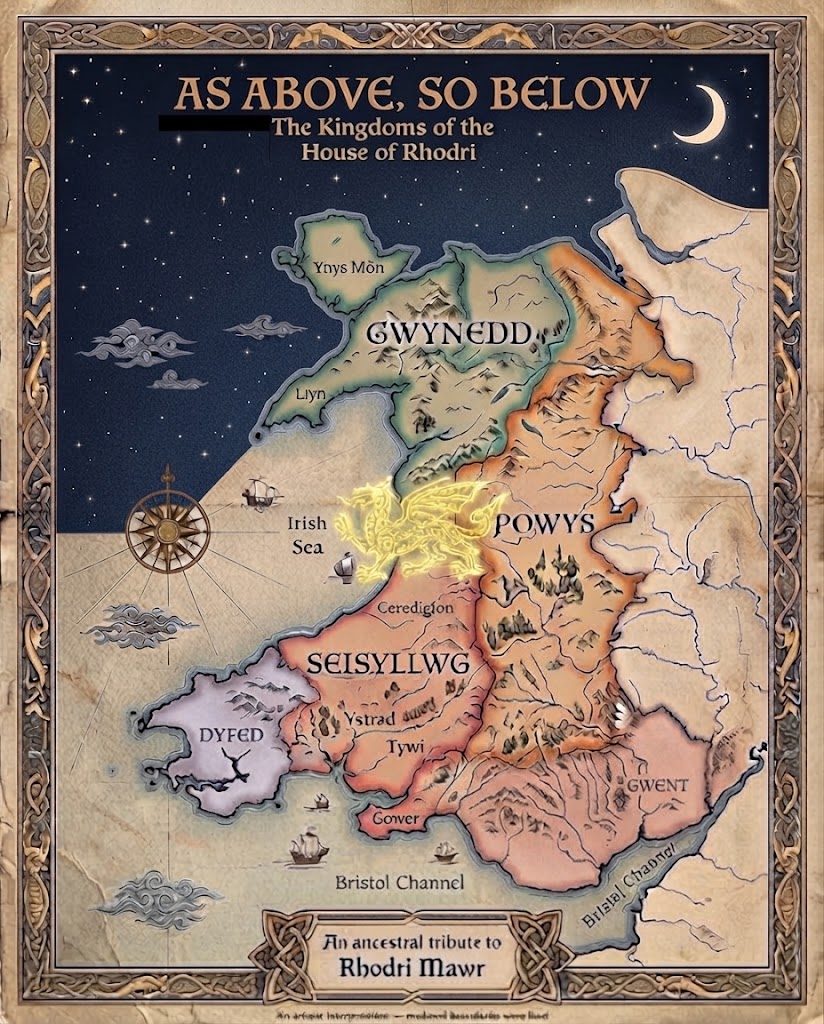
The heavenly kingdom of Wales is how I describe the mystical terrain of this narrative: ancestry, imagination, belonging, and the vision of what may still be possible.
As Above, So Below.
On the map, this vision begins to take shape.
Gwynedd.
Powys.
Seisyllwg.
Then Dyfed and Gwent.
Five Names, Five Colours: Envisioning a Unified Wales
This map stems from a fascination with Rhodri’s domain. The dialogue extends beyond mere history.
The family narrative stretches beyond the initial three coloured regions. As it blossomed, so did the vision.
It’s crucial to clarify this distinction:
We are not rewriting history while pretending it has always been this way.
We are imagining a future.
Our five-kingdom map represents a proposal articulated through narrative and art. Its borders delineate an idea rather than a claim that every element was once governed by a single ruler at a specific moment in time.
The House of Rhodri is the name under which I am gathering this concept.
The Castles Under the Guardian Dragon
Then the castles came into view.
If we are to discuss five kingdoms, we must identify the significant locations within our vision.
Fifteen castles emerged as our initial landmarks.
These are not the only castles in Wales, nor do they encapsulate the entirety of the story. They are fifteen sites from which we can begin to weave the threads of our narrative.
In our Gwynedd, we recognised Caernarfon, Conwy, and Harlech.
In our Powys, we identified Powis, Montgomery, and Dolforwyn.
In our Seisyllwg, we noted Cardigan, Dinefwr, and Carreg Cennen.
In our Dyfed, we acknowledged Pembroke, Carew, and Manorbier.
And in our broader Gwent, we named Caerphilly, Cardiff, and Chepstow.
There they stand.
Fifteen Castles, Five Kingdoms, One Wales
Within our vision of the House of Rhodri, each castle lies beneath the golden dragon.
This is how we fit them into the narrative; not by suggesting that all were constructed by our ancestors or that their histories began with us. Each castle has its own legacy, and this declaration does not alter its present guardianship or stewardship.
We are envisioning how these sites might belong to a shared future.
Some may enter our family narrative through a memory. Others through an undiscovered connection. Some may serve as spaces for reflection, prompting us to consider what we wish the next chapter of Wales to encompass.
Naming them brings the vision closer.
You can mention “five kingdoms” and leave people envisioning almost anything.
But mention Caernarfon. Mention Dinefwr. Mention Pembroke.
Suddenly, there are destinations to explore, questions to ask, and stories to uncover.
The map begins to transform into a realm you can journey through.
This is all well and good.
Before anyone wonders where I plan to store the keys to fifteen castles (that remains a secret!), I should remind you that this all began with the need to digitise my mother’s documentation.
We are tackling one responsibility at a time.
The Flag that Unites Our Vision
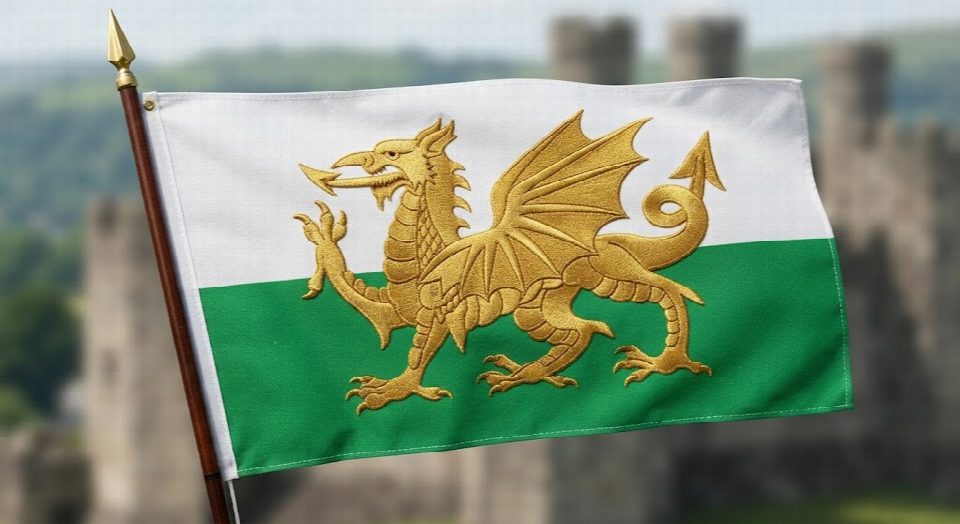
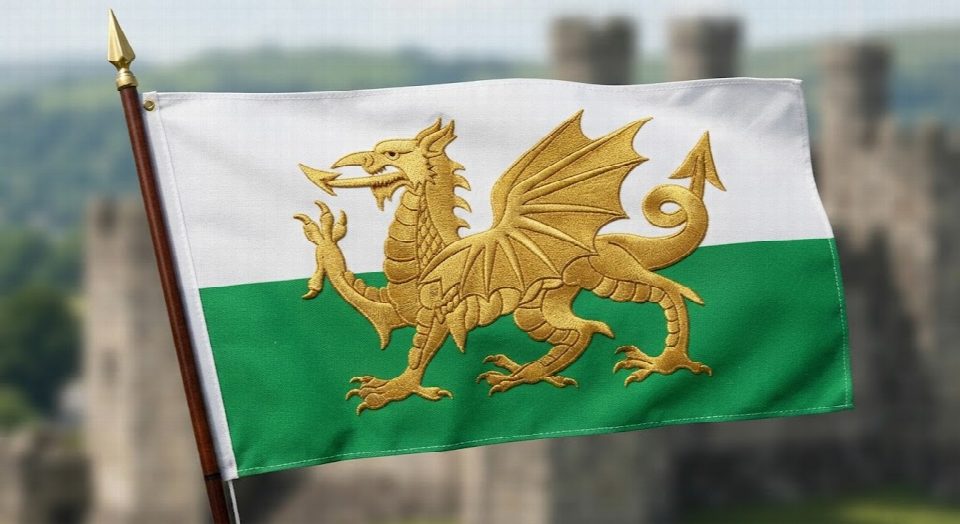
Next, we designed a flag for this vision.
For this proposed flag, we retained white above and green below, placing a golden dragon at the centre, where the red dragon typically resides. The red dragon signifies primal emotion, a force of will, fire, and ash. We replace it with intention, love, and fearlessness…
The white symbolises the heavens.
The green embodies the earth.
The golden dragon represents our aspirations for Wales’ prosperity within our vision of the House of Rhodri.
To me, the colours reflect the belief that God created both the heavens and the earth. They merge the mystical and the terrestrial into a single image.
As Above, So Below.
And beneath that imagery, our guiding principles:
Peace, Prosperity, Patience & Justice Under God.
-
Peace – not a demand for unanimous agreement, but a commitment not to impose consensus.
-
Prosperity – not wealth concentrated in a few hands, but the flourishing of individuals, communities, culture, and land.
-
Patience – because a future worth cultivating cannot be summoned into existence simply by proclamation.
-
Justice – because none of the other promises hold much weight if individuals cannot expect fair treatment.
“Under God” expresses my unwavering faith and the accountability I feel within it. It is not a necessity for everyone to share my beliefs.
No one should be required to profess a religion, accept a mystical assertion, or acknowledge something sacred in the dragon to enjoy equal dignity.
I would raise this flag as an invitation to contemplate a vision.
Not as permission to silence another’s voice.
What Do the Kingdoms Symbolise?
A map serves as an excellent starting point.
It is insufficient as a governing tool.
Eventually, someone is entitled to pose a practical inquiry.
What does this mean for the individuals living here?
That is a valid question.
A golden dragon is visually striking, but it cannot address grievances simply by shining more brightly.
The narrative requires a charter.
I do not recognise the current governmental structure as the future I envision for Wales. Yet, dissatisfaction, no matter how deeply felt, is only the beginning of a discussion.
If I am to articulate a different future, I must be prepared to explain it.
Not just who would occupy the centre of the map.
How power would be limited.
How individuals would be heard.
How someone could disagree with the House of Rhodri and remain just as free, just as safe, and just as Welsh as anyone else.
A Modern Charter for Our Future
To establish this foundation, we have chosen to draw inspiration from Cyfraith Hywel… the Laws of Hywel Dda.
This is not a literal restoration of every medieval law.
It is a contemporary charter grounded in that legacy, meticulously examined and tailored for the people who would live under it today.
This is the proposal we have begun to articulate.
No longer the Laws of the Sea, we demand the Laws of the Land…
Equal dignity.
Freedom of conscience.
Freedom of speech.
Leadership that is accountable for its decisions.
Justice that strives to remedy harm where possible while safeguarding those who have been injured.
Care for the land, the water, the minerals, the language, the traditions, and the places entrusted to us.
A meaningful voice for individuals throughout all five kingdoms.
These are commitments we must honour in practice, not mere phrases to place beneath an appealing image.
The charter must accommodate individuals whose beliefs diverge from mine.
There must be space for the mystic and the sceptic, the religious and the agnostic, the person who finds significance in the dragon and the individual who appreciates the artistry.
No one should need to share my mystical understanding to possess equal rights.
Justice Within Our Castles
Within this proposed future, the castles would serve a purpose beyond their geographical locations.
We envision them as venues for courts: places where justice is administered within the communities they serve.
This is not the current judicial system with a new flag hung above its entrance, but a proposed alternative whose authority would derive from an agreed charter and laws established openly with the consent of the people.
Our aim would be for all courts to convene within castle settings, wherever conservation, safety, and accessibility could be harmonised with that purpose. If a location could not accommodate an operating court, appropriate facilities would need to be considered without compromising the site we wish to honour.
Because a symbol is ineffective for justice if access is restricted.
Judgment would be entrusted to peers within the community governed by the new laws we propose.
“the community” must never become another term for the loudest voices within it.
A person should not lose a case because they are unpopular, unfamiliar, impoverished, or different.
Knowledge of someone’s reputation must not be confused with understanding the evidence.
The charter would need explicit protections: impartial selection, the removal of anyone with a conflict of interest, independent legal counsel, and a fair opportunity for each party to present their case.
Anyone accused would be presumed innocent unless the evidence against them meets the legal standard. They would retain the right to comprehend the accusation, receive legal aid, contest the evidence, and pursue an independent appeal.
Those who report harm would deserve safety, dignity, and support throughout the process.
Decisions must be accompanied by justifications.
The laws themselves should be public, comprehensible, and open to scrutiny and revision through agreed procedures.
No one—not a leader, not a relative, nor the founder of this vision—would have the authority to dictate a verdict.
Including me.
Especially if I happen to be standing beneath a particularly impressive dragon at the time.
Where harm can be rectified, the court would seek meaningful restoration. Where protection is necessary, it must be provided. Forgiveness may be freely offered, but never demanded from someone who has suffered.
This is the justice I aspire for these castle courts to pursue.
Not spectacle.
Not vengeance.
Responsibility, fairness, and a path forward.
These proposals envision a potential future, not courts we can establish simply by declaring their existence. Until any changes are legally instituted, the vision would not supplant existing courts or release anyone from their current legal obligations.
The Meaning Behind a House
When I use the term “House,” I intend it to convey a sense of responsibility.
My ancestry may help explain why I embarked on this journey. It does not elevate my worth above those alongside me.
It does not exempt me from the law.
And it cannot, by itself, grant me authority over those who have not chosen it.
Any future political structure would require the freely expressed consent of the populace, achieved through peaceful and lawful means.
Otherwise, we would have delineated five kingdoms without addressing the most critical question:
Whose home are we referring to?
Wales is already home to individuals with their own lives, beliefs, aspirations, and conflicts.
A meaningful vision must accommodate them.
The House, as I envision it, must be capable of listening as well as speaking.
If its proposals do not withstand scrutiny, then those proposals require further refinement.
Awakening to New Realities and Responsibilities
When I declare the Golden Dragon of Wales is awake, I am naming the awakening that resides at the core of this narrative.
My growing focus on family.
My quest for a language that encapsulates mystical experiences.
My desire to envision a Wales organised around belonging, responsibility, and justice.
The dragon serves as the symbol that unites these elements.
Its awakening does not serve as proof that I possess all the answers.
It marks the commencement of my inquiry into how I intend to engage with these questions.
What does my ancestry demand of me?
What does my faith require in terms of how I treat those who do not share it?
What am I prepared to adapt in my vision after hearing another’s perspective?
These questions are as integral beneath the flag as any declaration.
Our Place in the Ongoing Narrative
This is our current status.
A lineage being traced.
My mother’s research.
My own attempts to articulate experiences that hold significance for me.
Five kingdoms illustrated on a map.
Fifteen castles identified within the vision.
A proposed flag of white, green, and gold.
And the inception of a charter: a document to discuss, test, question, and refine.
There remains much that I do not yet know.
This is not a justification for fabricating the missing elements.
It is a call to continue seeking.
They call me Goldie The Grey.
The gold requires explanation.
The grey is self-explanatory.
If you arrived here expecting a demand for a throne, you may have to settle for a family narrative, a proposed charter, and an ambitious map.
All of which commenced with the quest to find a suitable place to store and digitise my mother’s research.
Peace, Prosperity, Patience & Justice Under God.
As Above, So Below.
The Golden Dragon of Wales is Awake.
The post The Golden Dragon of Wales Awakens appeared first on Limits Of Strategy.