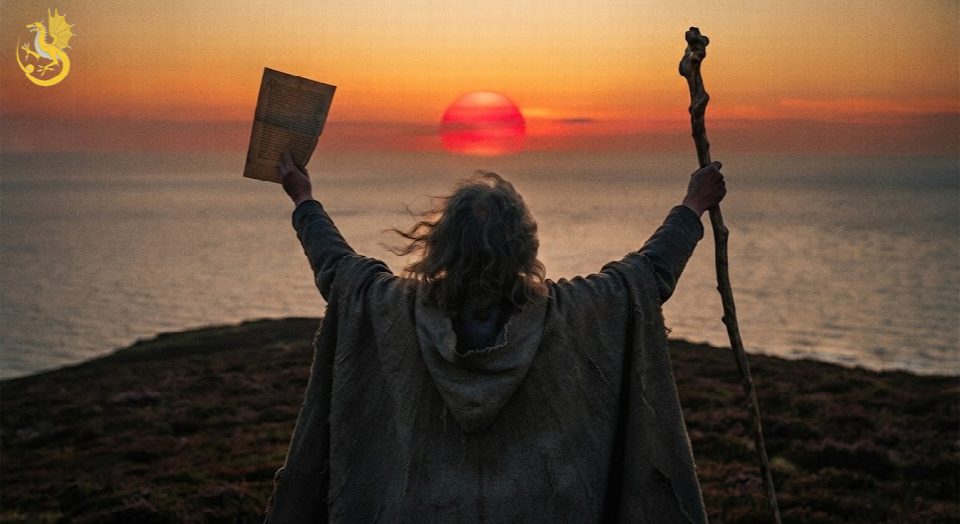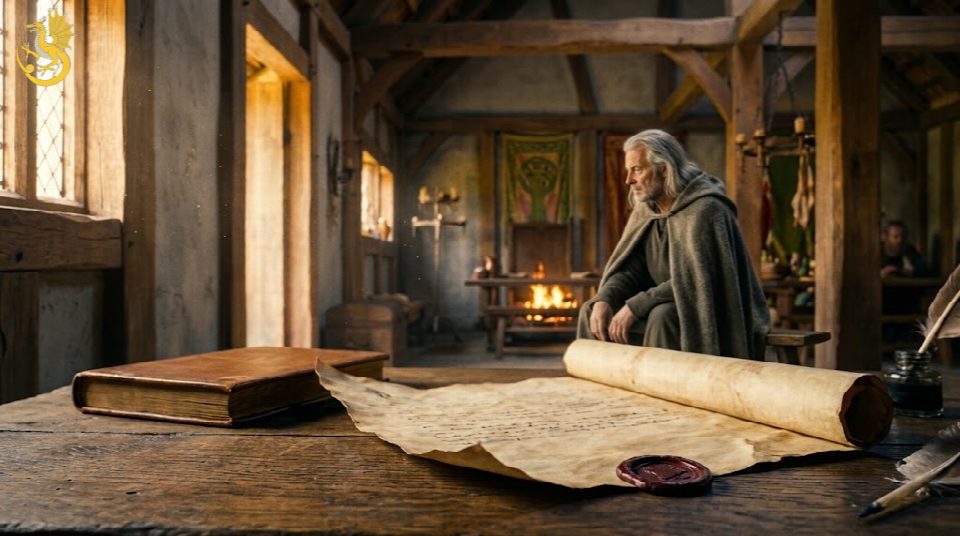
Begin an exploration beyond Rhodri Mawr into the captivating world of Merlin, uncovering ancestral links through Merfyn Frych, Llywarch Hen, and the rich heritage of early Welsh myths.
An exploration of ancestry through a landscape of princes, poets, and prophecies.
Unearthing Ancestry Beyond Rhodri’s Heritage
The story of my family has taken me back to Rhodri Mawr.
Thanks to my mother’s unwavering dedication, I have immersed myself in the names, relationships, and generations that intertwine our family’s narrative with the lineage of medieval Welsh rulers. What once felt like distant echoes from history books, castle inscriptions, or titles in ancient manuscripts has now evolved into a profoundly personal journey.
This quest for Rhodri raises an intriguing question.
Who were his ancestors?
A family tree invites us to ponder our origins. Each name is a connection to another, and every branch suggests uncharted paths. Eventually, we reach a point where the evidence becomes less substantial. The records grow scarce, genealogies become increasingly complex, and the stories surrounding these figures expand.
This does not signal the conclusion of our search.
Rather, it urges us to rethink the essence of our journey.
Now, I am tracing an ancestral legacy that extends beyond Rhodri, delving into a world preserved through poetry, royal lineages, and myth. Along this route stands a figure whose name transcends the borders of Wales.
In the Welsh tradition we are exploring, he is known as Myrddin: a bard, a prophet, and a man whose story intertwines with the woodlands and fallen kingdoms of early Britain. Tradition
His association with the famed Arthurian wizard has developed over centuries of storytelling.
I do not intend to claim that he is a direct ancestor.
The question is far more engaging.
How closely can the ancient ancestral tales connect us to his world?
Journeying Through Ancestry Before Rhodri: The Path of Merfyn

The first step back leads us to Rhodri’s father, Merfyn Frych. Genealogies
Merfyn ruled Gwynedd and passed away in 844. Documented
His father was Gwriad. The Dictionary of Welsh Biography describes Gwriad as a “reputed descendant” of Llywarch Hen, a notable figure linked to the northern British sixth century. Genealogies
This distinction is vital to our understanding.
The term “reputed” influences how we perceive the road ahead.
It doesn’t render the tradition uninteresting. Rather, it underscores that a claim of lineage and a verified lineage are not always the same.
The traditional lineage we are examining unfolds as follows:
Rhodri Mawr → Merfyn Frych → Gwriad → Elidyr → Sandde → Alcwn → Tegid → Gwair → Dwg → Llywarch Hen. Genealogies
This sequence has been maintained through medieval genealogical tradition rather than through a continuous set of contemporary records that validate every relationship. Variations in the spelling of names may also occur across different sources.
For a storyteller, these names carry a unique resonance.
Recite them aloud, and they begin to echo like footsteps.
Rhodri. Merfyn. Gwriad. Elidyr.
Each name pushes us further from the world we recognise and deeper into a past reconstructed from fragments.
We must resist the temptation to fill every silence with certainty. The claimed connection between Gwriad and Llywarch Hen is debated. We cannot unconditionally attach this entire sequence to a modern family tree and assume every generation is equally secure.
Instead, we should reflect on what the lineage signifies, what it claims, and where it might lead us.
In Merfyn’s case, it leads us unexpectedly.
Into a poem voiced by Myrddin.
The King as Voiced by a Prophet
A literary connection already exists between Merfyn Frych and the Merlin tradition.
This is found within a medieval Welsh poem titled Cyfoesi Myrddin a Gwenddydd ei Chwaer, often translated as “The Dialogue of Myrddin and Gwenddydd his Sister”. Documented
In this poem, Merfyn is identified as:
“Merfyn Frych from the land of Manaw.” Documented
For me, this marks the intersection of two paths on this journey.
On one side is Merfyn, father of Rhodri, a ruler whose place in Gwynedd’s history is well established.
On the other side is Myrddin, whose voice resonates within a literary tradition of prophecy.
The poem presents a dialogue between Myrddin and his sister Gwenddydd. Through their conversation, the prophetic voice foresees a series of future rulers, with Merfyn being part of that lineage. Documented
Here, “Documented” refers to the contents of the surviving poem, not to proof that its prophecies were genuinely articulated in the sixth century.
We need not assume this indicates an improbable encounter across the ages.
A later poet could weave known events into the words of a character imagined to have existed in an earlier time. What appears as a prediction within the narrative may reflect contemporary understanding during its composition.
Merfyn’s presence serves as evidence of his inclusion in the Myrddin literary canon, not proof that a sixth-century seer personally foretold his reign.
Yet, recognising this distinction does not diminish the significance of the discovery.
It provides tangible material for engagement.
We do not need to fabricate a conversation between Merfyn and Merlin. Medieval storytelling has already incorporated Merfyn’s name into the realm of Myrddin.
For the exploration of family history, this represents a remarkable convergence.
The ancestral path and the prophetic poem do not merge into one but, for a fleeting moment, they run parallel to each other.
Llywarch Hen: The Ancestral Figure at the End of the Lineage
If Merfyn serves as the literary connection, Llywarch Hen represents the human aspect at the earlier end of this tradition.
Llywarch is associated with the remembered realm of the Hen Ogledd, the Old North. Welsh tradition depicts him as a British prince linked to the northern kings. Tradition
Pedigrees also suggest he was a cousin of Urien of Rheged, a ruler connected to the latter half of the sixth century. Genealogies
It is not solely his position among kings that makes him fascinating.
It is the profound sense of loss that surrounds his name.
A cycle of poetry portrays Llywarch as an elder reflecting on conflict, familial bonds, and sorrow. Documented
The poems do not constitute a verified autobiography. Instead, they are literary creations centred around his character and the individuals and locations associated with him.
This distinction is significant, but it leaves us with an extraordinary character for storytelling.
An ageing prince.
A survivor.
A man whose narrative can be approached through lament rather than through the celebratory language of victory.
The traditions also connect him to the death of Urien and its subsequent ramifications. Tradition
Through this poetry, the northern past transforms from a mere sequence of rulers into a landscape rich with loyalties, grief, and remembrance.
This is where our journey takes a pause.
The names linking Merfyn and Llywarch guide us through the lineage. Llywarch compels us to stop and listen.
We can envision an old man surveying the remnants of his world, provided we acknowledge that this scene is our storytelling, not a recovered eyewitness account.
What has he endured?
What does he mourn?
What remains when the warriors who once populated the halls have departed?
These inquiries draw us closer to the emotional landscape of Myrddin.
Myrddin Wyllt: The Progenitor of the Enigmatic Wizard
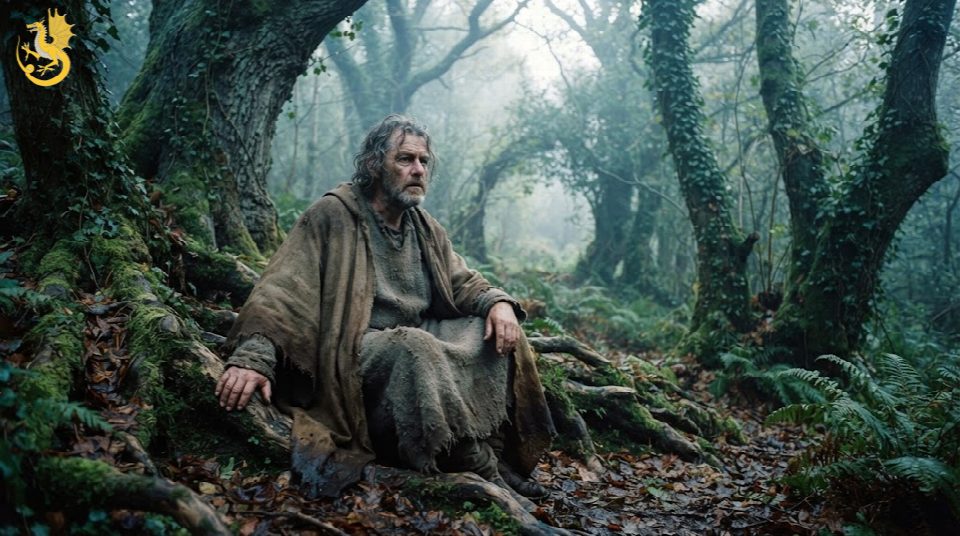
The Merlin many of us first encounter is a sorcerer standing alongside a king.
He exists in a world of enchanted swords, royal secrets, and extraordinary might.
The earlier Welsh Myrddin tradition presents a different character.
Myrddin Wyllt, or “Myrddin the Wild”, is linked to a sixth-century northern British context. In the traditional narrative, he serves Gwenddoleu and is overwhelmed by the tragedy of the Battle of Arfderydd, usually dated to 573. Tradition
Following the battle, he retreats into the woods and transforms into a wild, prophetic figure. Tradition
We should not equate this account with a fully substantiated biography.
Yet we can appreciate its emotional resonance.
This Myrddin does not emerge as a comfortable adviser seated beside a throne. He is part of a narrative that explores the impact of violence on an individual.
The hall yields to the forest.
The structured world of service and loyalty gives way to solitude.
Speech transforms into prophecy.
I exercise caution in attributing modern medical labels to a legendary figure. Nonetheless, a contemporary audience can resonate with the story’s focus on the trauma following battle without dismissing its supernatural elements.
Myrddin embodies both vulnerability and the extraordinary.
His separation from ordinary society amplifies the potency of his voice.
He is not entirely isolated within the literary tradition. The dialogue with Gwenddydd provides him with a companion who poses questions and elicits responses from him. The prophet has a sister, and the prophetic voice exists within a relationship.
This aspect enriches his character beyond the conventional depiction of an all-knowing wizard.
It offers us someone to listen to before we ask him to perform magic.
Where the Paths of Llywarch and Myrddin Intersect
Llywarch and Myrddin provide two distinct perspectives into the remembered era of northern British conflict.
One is the aged prince whose narrative revolves around loss.
The other is the wild seer whose tale focuses on the aftermath of battle.
Their connection does not require us to fabricate something from thin air. Historic Environment Scotland has published research examining the links between Llywarch Hen, Myrddin, the Battle of Arfderydd, and the landscape surrounding Caerlaverock. Documented
This does not allow us to assert that the two men definitively shared a fire at a specific time and place.
It provides a solid basis for exploring the traditions side by side.
We can let their voices resonate without forcing them into an imagined historical meeting.
Llywarch gazes into the past.
Myrddin looks towards the future.
One remembers those who have passed. The other speaks of those yet to come.
Between them stands the storyteller, striving to comprehend how the past endures when the people themselves have faded away.
Here, memory becomes the thread that binds the journey together.
It also connects this exploration to my mother’s research.
The distances are vastly different, and the evidence belongs to varied categories. Yet the desire to preserve names, relationships, and stories resonates profoundly with me.
We do not want those who came before us to vanish into oblivion.
Venturing South to Carmarthen: The Fort Beneath the Legend
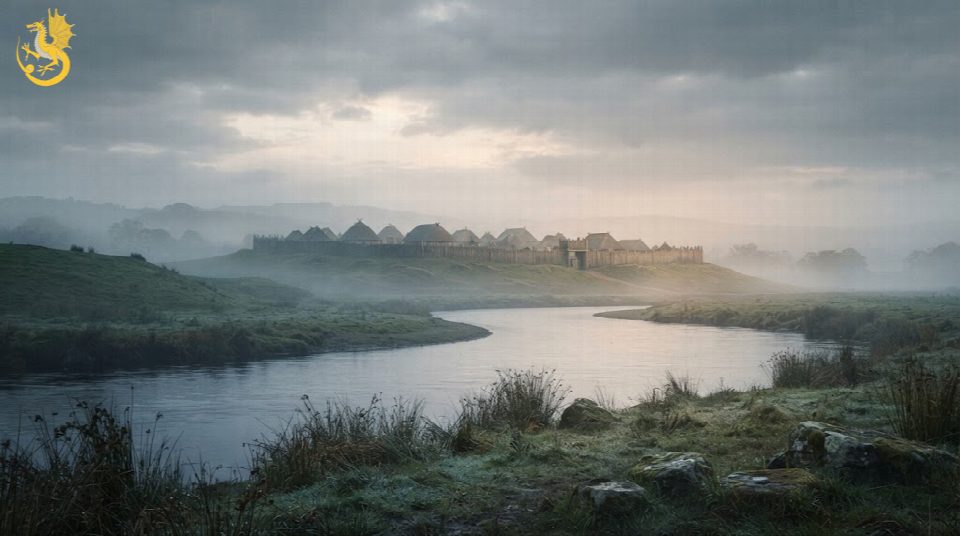
The northern landscape does not account for every aspect of the Merlin tradition.
Another narrative thread leads us south, to Carmarthen.
Here, the physical landscape extends its own invitation. Carmarthen evolved from a Roman military and urban site. The Roman town, Moridunum, became an administrative hub, and its history includes formidable defences. Documented
The later medieval castle represents a different chapter in the town’s evolution. Documented
It is essential to differentiate between the Roman fort, the Roman town, its fortifications, and the medieval castle.
These elements are linked by location but do not form a singular structure constructed at one moment.
The name itself adds another layer of meaning.
Caerfyrddin became associated with the interpretation “Myrddin’s fort” or “Merlin’s fort”. Tradition
The place-name has deeper roots in Moridunum, which translates to “sea fort”. Inferred
The legendary interpretation does not substantiate the claim that Myrddin possessed or resided in a fortress there.
For storytelling, I find this layering more intriguing than a straightforward assertion of ownership.
An ancient site endures.
Its name transforms.
Subsequent generations perceive something in that name and ascribe a narrative to it.
Ultimately, the distinction between place and legend becomes blurred in the collective imagination.
Carmarthen is also home to the Black Book of Carmarthen, a manuscript dating from approximately the mid-thirteenth century that safeguards vital early Welsh poetry, including material associated with Myrddin and the Arthurian tradition. Documented
This manuscript does not serve as a family register confirming our lineage to Merlin.
It represents another form of inheritance: words carried onward.
The Emergence of Arthur in the Narrative
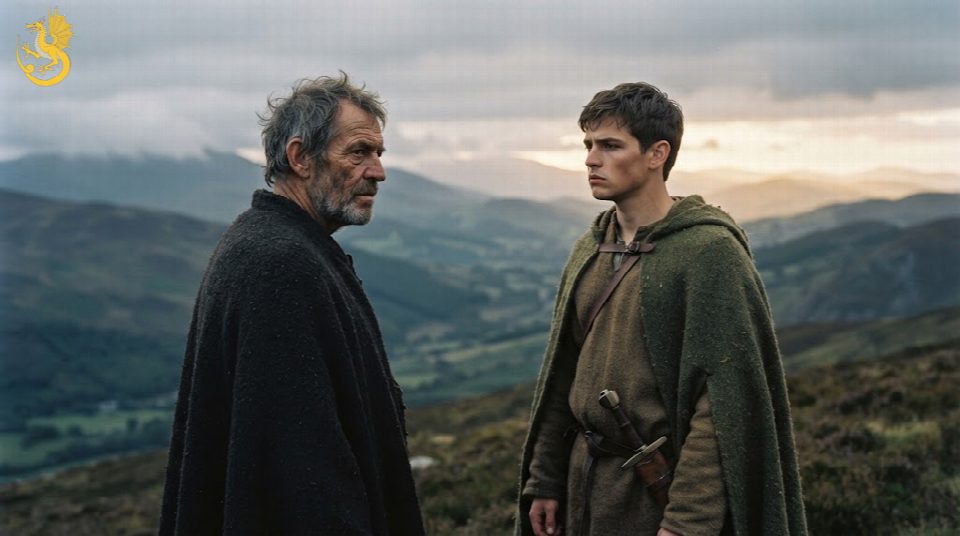
Arthur enters this narrative through the evolution of the legend, rather than through a verified branch of the family tree.
He already appears in earlier British accounts. The ninth-century Historia Brittonum depicts him as a military leader fighting alongside the kings of the Britons against the Saxons. Documented
This designation reflects the text’s assertions, not independent validation that Arthur engaged in the battles attributed to him.
These accounts were written long after the timeframe in which a historical Arthur is generally placed, leaving his historical identity ambiguous.
The grand literary fusion of Arthur and Merlin occurred through Geoffrey of Monmouth.
Around 1136, Geoffrey’s History of the Kings of Britain intertwines their traditions into a comprehensive narrative of Britain’s past. Merlin features in the tales of rulers predating Arthur and plays a critical role in the circumstances surrounding Arthur’s conception. Documented
Again, this serves as evidence of the literary narrative, not affirmation of the events it recounts.
This explains why the familiar Merlin feels larger than any singular early tradition.
He is the result of repeated storytelling.
The wild prophet, the interpreter of signs, and the figure linked to royal destiny became integrated into an ever-expanding Arthurian universe.
Arthur need not dominate this narrative.
He can stand at its periphery, illustrating the journey of the Myrddin tradition and the extent of its influence.
Our exploration began with names in a pedigree.
It has led us into one of the most enduring legendary realms in European literature.
Key Insights from Our Exploration
So what have we discovered?
No conclusive proof that Merlin is an ancestor.
No document identifying one of the figures in the lineage as the possessor of Carmarthen’s ancient fort.
And no justification for treating every medieval genealogical assertion as fact.
What we have unearthed is something far more fitting for a genuine storyteller.
Merfyn Frych, Rhodri’s father, is referenced in a poem belonging to the Myrddin prophetic tradition.
The contested pedigree leading to Llywarch Hen invites us into the remembered northern world explored alongside Myrddin in Welsh literary scholarship.
Carmarthen contributes another facet: an ancient fortified site, a name interpreted through legend, and a manuscript safeguarding the voices of medieval Welsh poetry.
These connections are diverse.
Maintaining their distinctions does not fracture the story. It shapes its essence.
We can transition from history to traditional ancestry, from ancestry to poetry, and from poetry to legend, without pretending that the boundaries have vanished.
For me, this is the allure of seeking beyond Rhodri.
The family tree does not simply terminate at the edge of certainty. It invites a different kind of inquiry.
What did subsequent generations believe about those who preceded them?
Which names did they choose to preserve?
Which voices did they ascribe to the lips of princes and prophets?
And why do those voices continue to resonate with us today?
I began by retracing my mother’s work through the generations.
Now, I find myself listening at the threshold of an older world.
There is Llywarch, in remembrance.
There is Myrddin, speaking to the future.
And between them, across all those centuries, a story remains to be told.
Further Reading Recommendations
The sources listed below provide historical, literary, and archaeological context for this exploration. They do not independently establish our modern family’s lineage, and the inclusion of a pedigree in a source does not verify every relationship contained within it.
Merfyn Frych and His Ancestral Heritage
-
Dictionary of Welsh Biography: Merfyn Frych, died 844, king of Gwynedd
A biographical entry detailing Merfyn’s lineage, identifying his father as Gwriad and describing Gwriad as a reputed descendant of Llywarch Hen. PDF. -
Gwriad ab Elidyr: Overview and Genealogical References
A secondary overview of Gwriad and the genealogical traditions surrounding him. Useful for orientation but not independent proof of the ancestral sequence. -
Legendary Ancestors of Rhodri Mawr and Angharad
A genealogical discussion highlighting issues with extending pedigrees beyond the more reliably attested generations. This is a community resource rather than a primary historical source.
Llywarch Hen and the Old North
-
Dictionary of Welsh Biography: Llywarch Hen
Background on Llywarch’s traditional lineage, associations with the North, and his significance in Welsh literary tradition. -
Historic Environment Scotland: Caerlaverock, the Battle of Arfderydd and Myrddin Poetry
Research exploring the relationship between landscape, early medieval Welsh tradition, Llywarch Hen, and Myrddin. -
Peter C. Bartrum: A Welsh Classical Dictionary, H–Ll
Reference entries for figures including Llywarch Hen, with citations to genealogical and literary sources. Hosted by the National Library of Wales. PDF.
Myrddin and the Prophetic Poetry
-
BBC Wales: Early Welsh Literature, Merlin
An accessible introduction to Myrddin and the development of the Merlin tradition. -
Peter C. Bartrum: A Welsh Classical Dictionary, M–N
Includes the reference to Merfyn Frych “from the land of Manaw” in the poem Cyfoesi Myrddin a Gwenddydd ei Chwaer. Hosted by the National Library of Wales. PDF. -
An Edition of the Welsh Merlin Poetry
A collaborative scholarly project involving Cardiff University, the University of Wales Centre for Advanced Welsh and Celtic Studies, and Swansea University. -
Concerning the Name Myrddin
A discussion of scholarly interpretations of the name Myrddin and its connections with Caerfyrddin.
Carmarthen and the Black Book
-
Heneb: Carmarthen Historic Landscape Characterisation
Archaeological and historical context surrounding Carmarthen’s development, including its Roman and medieval phases. -
National Library of Wales: The Black Book of Carmarthen
An introduction to the manuscript, including access to a digitised version. -
National Library of Wales: Ghosts from the Past Brought Back to Life
Background on the contents, dating, and significance of the Black Book.
Arthur and Geoffrey of Monmouth
-
Amgueddfa Cymru, Museum Wales: Who Was King Arthur?
An overview of Arthur’s appearances in early sources and the challenges of differentiating history from legend. -
BBC Wales: Geoffrey of Monmouth
Information on Geoffrey’s writings and his role in intertwining the narratives of Merlin and Arthur.
The post In the Footsteps of Merlin: Before Rhodri Mawr appeared first on Limits Of Strategy.